
Over 4,200 households across 26 wards in South Fly District of Western Province are experiencing a brighter future thanks to a solar lighting initiative delivered under the PNG-Australia Partnership.
The solar project is an activity in collaboration with the Western Province Provincial Administration.
For communities that previously relied on kerosene lamps and firewood, the solar kits provide clean, reliable light that improves daily life and household safety.
The initiative supports Papua New Guinea’s national goal of 70% rural electrification by 2030.
The Australian-funded South Fly Rangers Program is supporting this work, as they are uniquely positioned to deliver the solar household kits project: they are trained to collect data, work hand-in-hand with communities, and navigate South Fly’s challenging marine and riverine environment.
The rangers work with community leaders and Ward Development Committees to help identify and verify beneficiary households, strengthening transparency and community ownership. Distribution prioritised inclusivity, reaching 857 female-led households and 304 households headed by people with disabilities, reinforcing the partnership’s commitment to gender equality, disability and social inclusion.
Early feedback from communities shows clear benefits: children can study after dark, households feel safer at night, and spending on kerosene and disposable batteries has reduced. In some communities, health workers report solar lighting helps them respond to night-time emergencies.
Garma Mudu, a village elder from Wamorong Ward 17, highlighted the benefits of the new lighting sources. "We used to rely on hurricane lamps and battery-operated lights, which were unreliable. Now, with solar, our mothers can weave crafts like mats and fans at night, while our children can study without obstacles," Mr. Mudu said.
The impact on women’s safety and economic empowerment has been significant. Peti Aia, a women’s representative from Wamorong, described how solar lights have improved daily life.
"Before solar lights, we had to burn coconut leaves and tree bark to navigate at night, often going to the toilet in pairs for safety," Ms. Aia explained. "Now, parents can invest in lighting that illuminates their entire homes, allowing us to weave mats and fans for sale without the limitations of daylight."
Ms. Aia also noted that mothers can now produce four to five mats in a single night.
The solar kits also improve connectivity, allowing families to charge phones reliably and stay in touch with relatives across the country.
Australia remains committed to partnering with Papua New Guinea to deliver and expand access to clean, renewable energy solutions that foster community resilience and growth, and illuminate lives for a brighter future.
ENDS
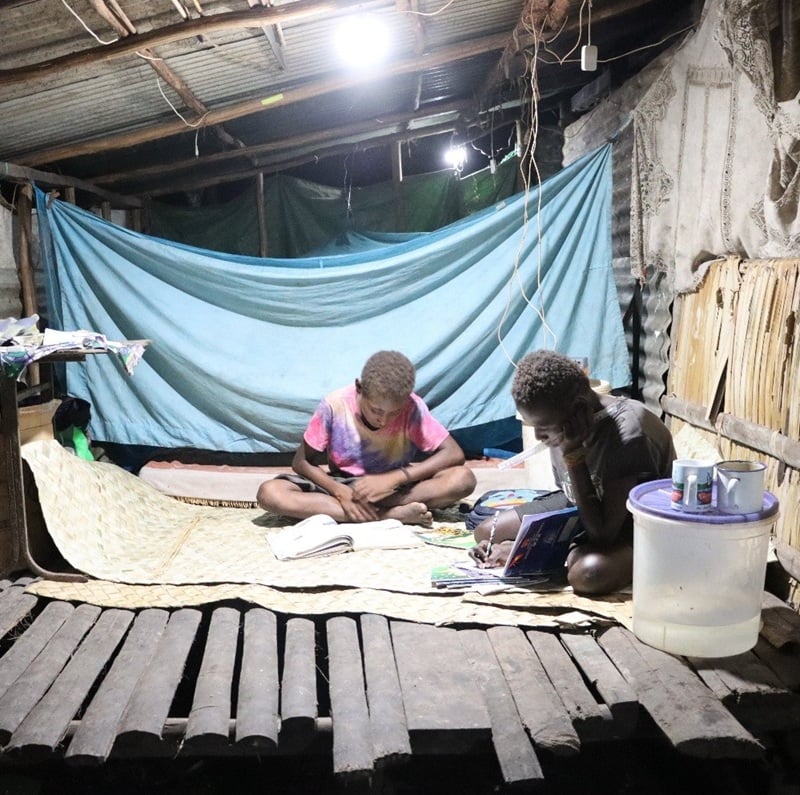
Solar lights used at night by children to study.
For further information, including access to related materials, please contact the Australian High Commission media team: +675 7090 0100